Where the money goes
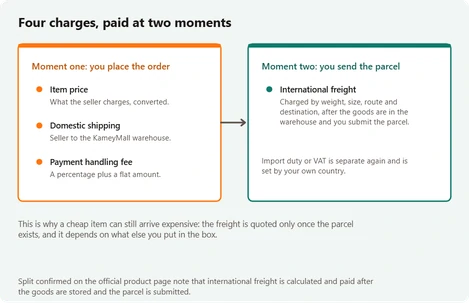
A first order feels cheap and then arrives expensive, and the reason is structural rather than dishonest. There are four separate charges, they are not presented together anywhere, and the largest of them is quoted last.
Nothing on this page is a rate card. KameyMall sets its own charges and couriers set the freight; both change. What follows is the structure, so that when you do see numbers you know what you are looking at.
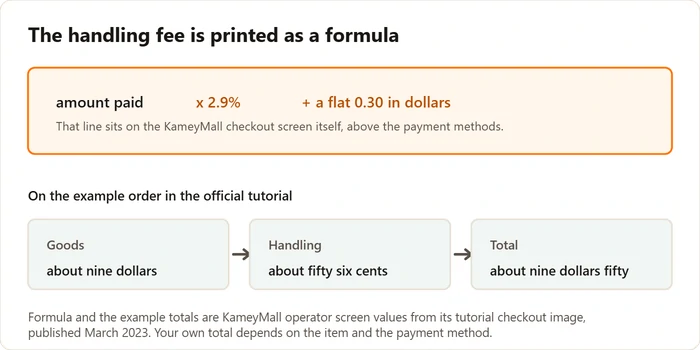
The only charge published as a formula
The March 2023 checkout illustration shows a handling calculation of 2.9% plus US$0.30 for its example payment. That is evidence of the illustrated historical checkout only; it does not establish a current fee, a universal fee across methods or why the operator set it.
To compare present payment methods, use the total charged and the amount credited after conversion and fees. A fixed transaction component can matter more on a small payment, but batching payments does not remove seller, packing or freight costs. Read the current checkout before deciding.
Why the freight cannot be quoted at the start
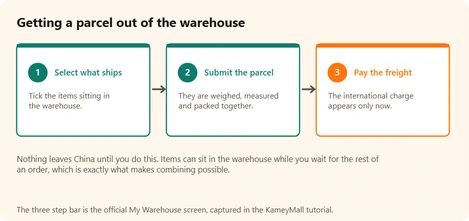
The international charge is calculated per parcel, and the parcel does not exist when you order. KameyMall says so on the product page: no overseas price is worked out until the goods have been put into storage and you ask for them to be sent.
That is not evasiveness. Freight depends on the finished box: its actual weight, its dimensions, the route you pick and where it is going. Two jackets may cost less together when that avoids two minimum parcel charges. A bulky combined box may instead trigger volumetric billing or a route limit, so compare the actual options.
Let eligible items gather when the storage window allows, then compare combined and separate packing quotes.
How long it takes, in KameyMall numbers
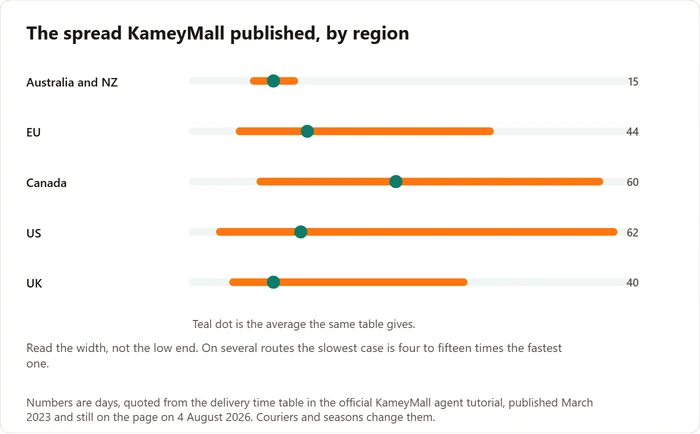
KameyMall published a delivery time table in its own tutorial giving a shortest, average and longest figure in days for five regions. We are reproducing it because a published range from the operator is more useful than a guess from us, but read it for its width rather than its optimism.
On the United States row the longest figure is more than fifteen times the shortest. On the European Union row it is more than six times. A table like that is not telling you how long your parcel will take. It is telling you that the route, the season and the courier decide, and that the old averages cannot establish a current arrival date.
The service page saved in August 2026 described one working day for parcel processing and two for dispatch; the older tutorial allowed time before tracking became active. These are historical statements, not verified current service levels.
The four charges, and who sets each one
Knowing who sets a charge tells you who to ask about it, which saves a lot of time when something looks wrong.
| Charge | When you pay it | Who decides it |
|---|---|---|
| The goods | At the order | The seller on the source marketplace |
| Domestic shipping in China | At the order | The seller, shown as a domestic freight field |
| Payment handling | At the order | Printed as a formula on the checkout screen |
| International freight | When you submit the parcel | Weight, size, route and destination |
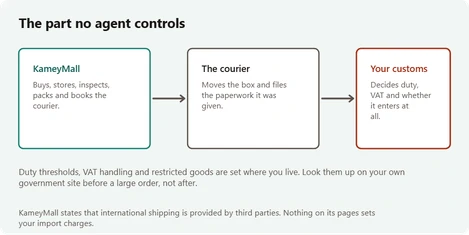
| Import duty or tax | On arrival, if charged | Your own country, not KameyMall |
Combining versus sending things one at a time
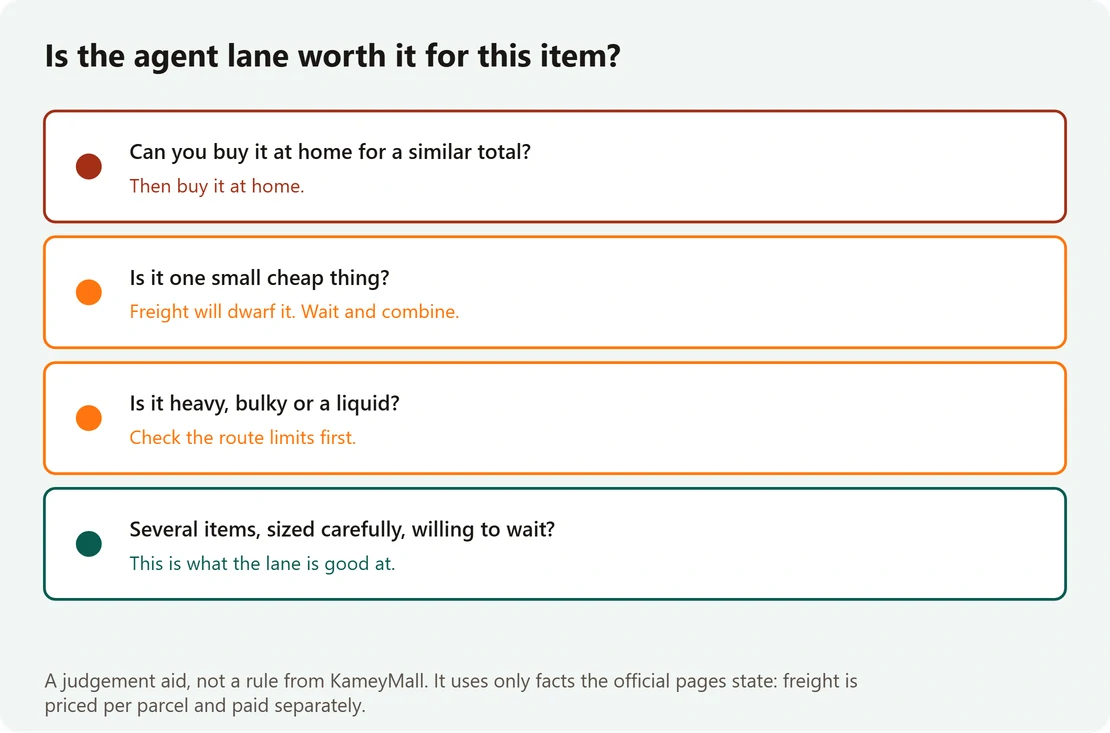
This is the decision the warehouse screen exists for, and it is worth being deliberate about rather than clicking through.
Combining pays when
- You are waiting on two or more sellers anyway
- The items are small and light, so one box absorbs them
- You care more about the total than about having it this week
- The goods are all going to the same address
Sending separately pays when
- One item is urgent and the others are not
- One item is heavy or bulky enough to push the box into a worse bracket
- One item is restricted on the route the others can use
- You are near a customs value threshold you would rather not cross
The numbers we leave out on purpose
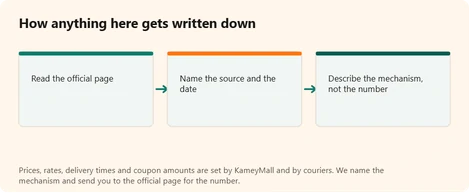
We will not print a freight rate, a service fee percentage, a coupon amount or a storage allowance. Not because they are secret, but because they are set by KameyMall and by couriers, they change without notice, and a stale number in a guide is worse than no number. The few figures you will find here each come with a named origin and a checking date.
KameyMall does provide a shipping calculator on its own site. We have not described its fields here because we have not used it in a signed in state, and describing an interface we have not seen is how guides end up wrong.
Official site status, checked 20 October 2026: www.kameymall.com did not load for us, so links to it are paused until it does. The calculator sits in the official Logistics Center section.
Compare two parcel quotes on the same basis
Write down the destination, packed weight, dimensions and item restrictions before comparing routes. A cheaper number based on a different box or on goods that the route will not carry is not a usable alternative.
- Check whether the line uses actual weight, volumetric weight or a comparison of the two. Clothing is not automatically billed by actual weight; a bulky padded coat can make the box dimensions decisive.
- Check which packing services are already included and which add a charge. Keep fragile parts protected even when removing unnecessary packaging.
- Read how the estimate is reconciled after packing. Ask whether an extra amount may be due and where any balance is returned.
- Read the present restrictions and claim terms for that route. A general page about the platform does not replace the terms attached to the service you select.
Consolidation is a comparison, not a promise
For two orders from different sellers, compare one combined package with two separate packages after the goods and their dimensions are known. Combining may avoid repeated base charges. It may also create an oversized parcel, delay an urgent item or put a restricted item alongside otherwise straightforward goods. Keep the two estimates and choose the option that fits your priorities.
A budget should leave room for charges outside the agent checkout. Check the destination’s current import rules and whether the selected route includes any tax handling. Do not assume a freight label means every possible charge has been prepaid.